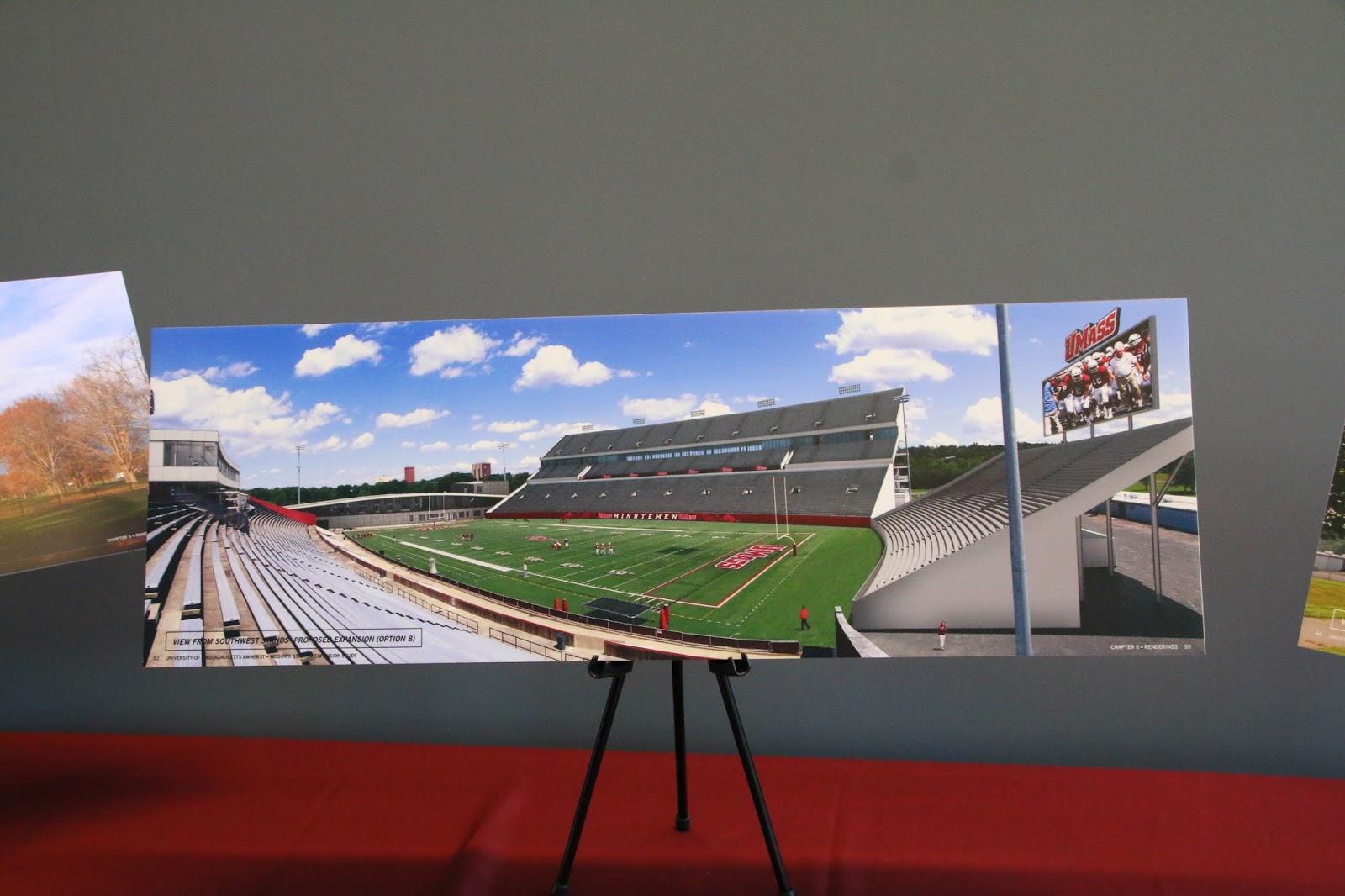
See what you are saying, but the picture is labeled option B. Not sure the picture you are showing is also option 'B'.
Bottom line it's years away and not sure what the 20-25k option is.
According to the RFP, they want to reuse if possible the video board structure or build it in the same area.
From RFP:
Videoboard and Public Address System
1. The primary scope of work for the study is the replacement of the current south
end zone score board with a new LED videoboard. The specific equipment
associated with the videoboard, north end zone scoreboard, and public address
system are specifically detailed in the Technology Schematic Design Report. In
addition to this equipment, the cost estimates should include the following work
items.
a. Remove and dispose of existing scoreboard wall-mounted speakers.
b. Alter existing scoreboard structure to accommodate new videoboard.
c. Incorporate camera platform and ladder access.
d. Installation of videoboard, public address speakers, and north end zone
scoreboard.
e. Evaluate potential for existing scoreboard and speaker re-sale or donation.
f. Provide landscaping (low plantings and new planting soil) around the
outside perimeter of the existing chain link fence scoreboard enclosure.
II. TECHNOLOGY
Introduction
A. The McGuirk Alumni Stadium at UMass – Amherst includes a single, standard definition
video scoreboard and two sets of speakers/horns at the south end of the stadium. The
video component is not used during games. Instead, a portable videoboard is rented and
brought on site at the southeast corner of the stadium on game days. The University is
planning the replacement of the scoreboard with a new high-definition LED videoboard. As
part of this replacement, the University is considering either reusing the existing audio
equipment or replacing it.
B. It is preferred to use the existing scoreboard structure for the new videoboard. However,
at the time of this report, the condition and capacity of that structure is unknown. The exact
dimensions of the existing scoreboard are also unknown. During a February 2018 site visit,
the scoreboard was estimated to be 20’H x 42’W with the bottom edge of the scoreboard
at 20’AFG.
C. The University has completed several similar projects at other venues on campus recently
using solutions from Daktronics. To keep materials, controls, and maintenance consistent,
the proposed solutions herein are that of Daktronics.
Videoboard
A. General Description
1. The new videoboard will consist entirely of high-definition, LED panels, mirroring
the dimensions of the existing scoreboard. There will be no static ad panels or
static scoring components of the new videoboard, however, that information can
be created by the UMass video production team and displayed on the LED board.
2. LED videoboards are constructed of many smaller LED panels (modules) put
together to achieve the overall size of the videoboard with an appropriate aspect
ratio. The modules consist of rows of thousands of red, green, and blue (RGB)
diodes that produce the colors of the images being displayed. The specifications
of the modules, specifically related to the RGB light emitting diodes is significant
when comparing videoboard options and solutions.
3. One of the biggest factors to consider regarding the displayed images and how
they are perceived by the audience is the pixel pitch. Pixel pitch is the spacing
between the RGB rows and columns on the modules. The smaller the distance
between the LEDs, the higher the resolution. In turn, the cost increases with the
higher resolution LED modules. For the project, a 13HD and 15HD solution are
being considered.
B. LED Videoboard
1. The most common solution for a collegiate stadium of this size and type is the
Daktronics 13HD LED display. The 13HD model represents 13.063mm (0.514-
inches) row and column spacing between the LEDs. This reduced dimension
results in a high quality, high-definition image. The 13HD display videoboard
includes the following specifications:
a. Overall Dimensions: 19.2’H x 42’W
b. Pixels: 28 x 28
c. Refresh Rate: 4,800Hz
d. Number of Modules (HxW): 16 Modules x 35 Modules
e. Matrix Size (HxW): 448 pixels x 980 pixels
f. Weight: up to 9,000 lbs.
g. Power: 5,708W (average); 22,830W (max)
2. The minimum recommended solution for this project is the Daktronics 15HD –
15.24mm (0.6-inches) row and column spacing between the LEDs. This solution
is lower cost and lower resolution than the 13HD. The 15HD display videoboard
includes the following specifications:
a. Overall Dimensions: 19.2’H x 42’W
b. Pixels: 24 x 24
c. Refresh Rate: 3,840Hz
d. Number of Modules (HxW): 16 Modules x 35 Modules
e. Matrix Size (HxW): 384 pixels x 840 pixels
f. Weight: up to 8,000 lbs.
g. Power: 10,094W (average); 28,837W (max)
3. Other specifications such as LED Lifetime, Brightness, and Viewing Angle are
consistent between the 13HD and 15HD solutions. Both solutions also include a
primary and backup, rack-mounted Daktronics control system.
a. The new LED videoboard will be able to display content similar to the
portable videoboard that has been used on game days. Existing UMass
production equipment will connect to the videoboard control system to
broadcast live and replay video, generate and display game information,
ads, etc.
C. Videoboard Cost Comparison
1. The costs listed include equipment only.
a. 13HD: $400,000
b. 15HD: $340,000
2. Installation costs can range from $100,000 - $200,000 depending on the existing
structure review. These costs do not include the cost of a new structure to support
the videoboard and speakers.
3. With the LED videoboard, it is recommended to replace the two (north and south
end zone) delay-of-game clocks which were observed to have some damage to
the enclosure. The cost for (2) game clocks is $4,300.
Be proud of the present and look to the future.