Coverage from:
UMass Athletics
The Springfield Republican 
The Boston Globe
The Daily Hampshire Gazette
The Daily Hampshire Gazette - quotes
The Daily Hampshire Gazette - column
The Massachusetts Daily Collegian
The Massachusetts Daily Collegian - column
The Massachusetts Daily Collegian - column
The North Adams Transcript
The Springfield Republican
The Springfield Republican - column
In Memory: Jack Leaman, 1932-2004
From UMass Athletics, 3/7/2004
 or over 40 years, the names of Jack Leaman and UMass basketball have been synonymous. Ever since his appointment as assistant basketball coach in 1961, it has been hard to talk about UMass hoops without Leaman's name entering the conversation.
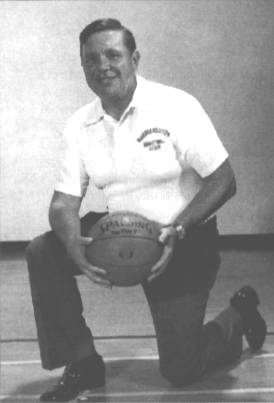
Jack Leaman as UMass coach. |
After five years as an assistant coach under Matt Zunic and Johnny Orr, Leaman took over as UMass' head coach prior to the 1966-1967 season. He would go on to lead the UMass basketball program for 13 seasons, compiling a career record of 217-126. The all-time winnings coach in school history, Leaman guided UMass to eight Yankee Conference titles in a nine-year span (1968-1971, 1973-1976), and six National Invitation Tournament appearances (1970-1971, 1973-1975, 1977). A two-time New England Coach of the Year, Leaman coached Basketball Hall of Famer Julius Erving, Louisville head coach Rick Pitino, Boston College head coach Al Skinner and UMass Athletic Hall of Famers Bill Tindall and Joe DiSarcina. Leaman coached 22 All-Yankee Conference selections during his tenure at UMass.
Following his time at head coach, Leaman remained with the UMass athletic department in a variety of roles. He served as the athletic director of UMass' Stockbridge School of Agriculture, as well as the Stockbridge men's basketball and golf coach. Leaman also served as the UMass head women's basketball coach in 1986-1987, leading the team to a 14-12 record, the school's only winning mark from 1980-1995. In addition, he spent three seasons as an assistant women's basketball coach from 1991-1994.
Beginning with the 1994-1995 basketball season, Leaman took a role as a color commentator on radio broadcasts of all UMass men's games. Three times during those 10 seasons (1996, 2001 and 2003), Leaman teamed with announcers Bob Behler and Mark Vandermeer to earn Best Play-By-Play honors from the Associated Press.
A Boston native, Leaman graduated from Cambridge Rindge & Latin High School in 1951. Following a two-year stint in the United States Army, from which he was honorably discharged in 1955, Leaman went on to earn both a bachelor's degree (1959) and a master's degree (1960) from Boston University. As a basketball player, Leaman led the Terriers in both scoring and assists during each of his three seasons. As a senior captain in 1959, he guided the Terriers to an overall record of 20-7, and a trip to the NCAA East Regional final.
Leaman was inducted into the Boston University Athletic Hall of Fame in 1977, the UMass Athletic Hall of Fame in 1998 and the New England Basketball Hall of Fame in 2003.
Leaman passed away on March 6, 2004. The hearts and thoughts of those at the University of Massachusetts are with all of Leaman's family and friends, especially his wife, Rita, and his daughter, Laura.
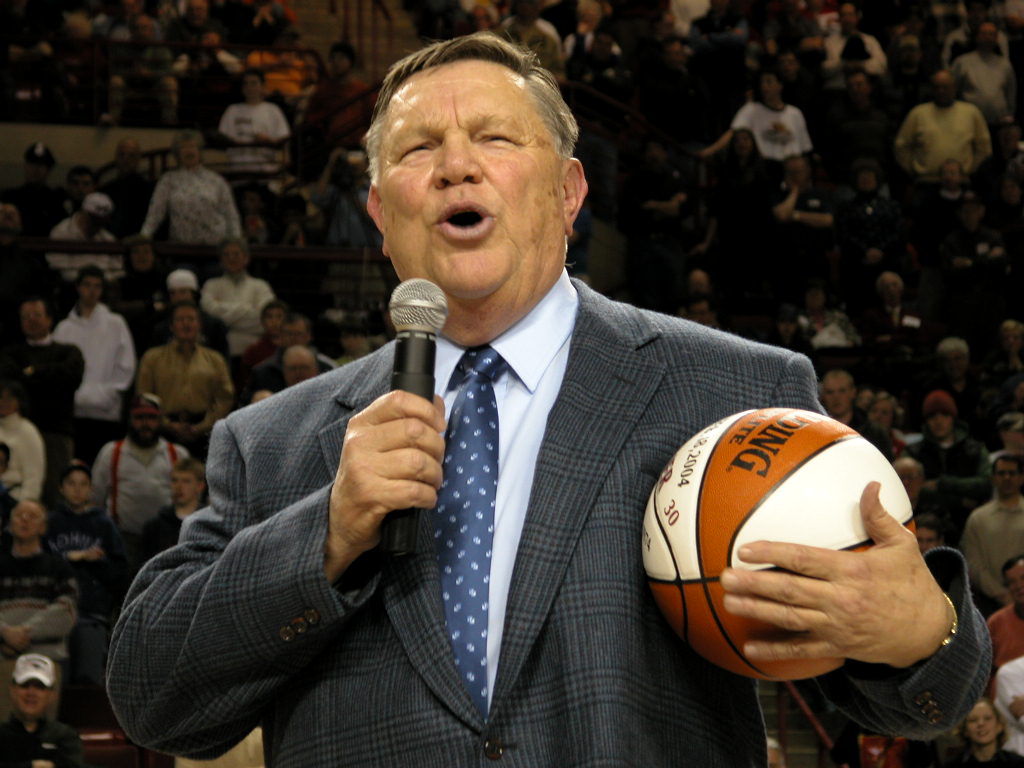
Leaman at Al Skinner night, 2/18/2004.
Jack Leaman, 71, coach, icon of UMass basketball team
By Judy Van Handle, The Boston Globe Staff, 3/8/2004
 ack Leaman, who coached Julius Erving at the University of Massachusetts and was involved with basketball at the school for more than 40 years, died late Saturday while returning from a game in Richmond, Va.
Mr. Leaman, a radio color announcer for the UMass men's team, was stricken by a heart attack while switching planes at Dulles Airport and died in Washington. He was 71.
Mr. Leaman was a signature figure within the university's basketball program and athletic department. With a 217-126 record over 13 seasons, from 1966 to 1979, he is the winningest basketball coach in the school's history.
He also was two-time New England Coach of the Year and led UMass to eight Yankee Conference titles in nine seasons and to six berths in the National Invitation Tournament. And although he is best known for coaching Erving from 1969 to 1971, two well-known coaches -- Rick Pitino, the former Celtics coach who now heads the University of Louisville's program, and Boston College's Al Skinner -- also played for Mr. Leaman.
"I felt like someone in my family had died," said Skinner when he learned of Mr. Leaman's death. "He treated people well. He always wanted the best for all his players. He just did what he thought was the right thing to do to get the most out of their talents. He pushed you to be the best player you could be.
"Jack wasn't really a complicated individual. He wore his emotions on his sleeve. You know if he liked you or didn't, and I appreciated that and respected that."
Skinner and Erving last saw their former coach at a Mullins Center ceremony when UMass retired Skinner's number on Feb. 18.
"When I heard about his passing, the first thing I thought about was that I was glad to see him under those circumstances -- with former teammates and fans," Skinner said.
UMass coach Steve Lappas said Mr. Leaman was a constant presence with the team, attending practices and meals and offering advice. "He was like my mentor in a lot of ways," Lappas told the Associated Press. "He was a connection to UMass tradition."
Mr. Leaman was born in Cambridge in 1932 and played basketball under former BC great Joe Koslowski at Cambridge Latin High School.
"I wanted to be a coach before I got to college," Mr. Leaman told the Globe's Bob Ryan in 1977, "and I had the perfect teacher in Mr. Koslowski. He was more concerned with teaching the game than he was with winning games."
After serving for two years in the Army, Mr. Leaman enrolled at Boston University and led the Terriers in scoring and assists in each of his three varsity seasons. In 1959, his senior year, Mr. Leaman was a co-captain when BU compiled a 20-7 record and advanced to the NCAA East Regional final before losing to West Virginia.
He was inducted into the BU Athletic Hall of Fame in 1977.
After earning his master's degree from BU in 1960 and serving for one year as a high school coach, Mr. Leaman was hired as an assistant coach at UMass in 1961. After replacing Johnny Orr in 1966, Mr. Leaman went on to post winning records in 11 of his 13 years as head coach.
Upon resigning after the 1978-79 season, Mr. Leaman filled many jobs within the UMass athletic department. He was women's basketball coach in 1986-87 and worked three seasons as an assistant women's coach, 1991 to 1994.
Mr. Leaman also served as athletic director of UMass's Stockbridge School of Agriculture and was Stockbridge men's basketball and golf coach.
He began work in 1994 as a color announcer on radio broadcasts for UMass men's games.
Mr. Leaman was inducted into the UMass Athletic Hall of Fame in 1998 and the New England Basketball Hall of Fame last year.
He leaves his wife, Rita, and a daughter, Laura, a 1985 UMass graduate, both of Amherst.
The family will hold a private funeral service; the university is planning a public memorial service at a later date.
With team until the last, UMass coach, confidant Jack Leaman is mourned
By Matt Vautour, Daily Hampshire Gazette Staff Writer, 3/8/2004
 MHERST - Jack Leaman hadn't officially been the University of Massachusetts men's basketball coach for almost 25 years, but he was still coaching in the final days of his life.
Mr. Leaman, 71, died Saturday after suffering an apparent heart attack at Dulles International Airport in Washington, D.C.
Mr. Leaman, who had been an analyst on radio broadcasts of UMass games since 1994, was on a layover as he traveled with the team back from its final regular-season game in Richmond, Va.
UMass sophomore forward Jeff Viggiano credited a conversation he had with Leaman just days before his death for helping to pull him out of a shooting slump.
Mr. Viggiano was one of the many people associated with Leaman during his 43 years at UMass who mourned his passing.
''It's obviously a tremendous loss for the UMass community and the entire basketball community,'' said Ray Ellerbrook, who was a member of Mr. Leaman's first recruiting class and is now the superintendent of Look Park in Northampton. ''He touched so many people in basketball. He's one of those guys that you're a better person just for knowing him.''
In remembering Mr. Leaman Sunday, few people talked about his game tactics or on-court successes. While those gave him a measure of local fame, it was his personality and warmth that made him one of the region's most beloved figures.
UMass Associate Athletic Director Thorr Bjorn said the family will hold a private funeral this week. Mr. Leaman, who was an Amherst resident, leaves his wife, Rita, and their daughter Laurie.
Mr. Bjorn said a public memorial service will be scheduled after the basketball season to allow Mr. Leaman's many friends in the college basketball community to attend.
Began in 1961
After a standout career at Boston University, Mr. Leaman began his sideline career in 1961 under Matt Zunic, who had been his coach at BU before taking over in Amherst.
Mr. Leaman assisted Mr. Zunic and then Johnny Orr before being named the UMass head coach for the 1966-67 season.
He only had two losing seasons - his first and his last - with 11 winning ones in between. Mr. Leaman's teams won eight Yankee Conference Championships and went to six National Invitation Tournaments.
He coached Julius Erving, who was honored as one of the NBA's top 50 players of all time, and current Division I head coaches Rick Pitino (Louisville) and Al Skinner (Boston College).
Mr. Leaman was the UMass men's program all-time winningest coach, with a record of 217-126. But he was as proud of his players' successes in life as he was of their basketball victories.
''Jack was more than a coach. He taught me how to be a man,'' said Mr. Pitino. ''He taught me to be selfless, to put the team over the individual. He taught me so much more than basketball. He made me tough. I owe so much to him.''
Mr. Ellerbrook's sentiments were similar.
''He wanted you to be successful, no matter what you were involved with,'' Mr. Ellerbook said. ''He pushed all of us to get our degrees.''
Mr. Leaman retired as the men's coach after the 1978-79 season, but he stayed around the athletic department.
For years he coached the basketball and golf teams at the Stockbridge School of Agriculture, the two-year associate degree program at UMass.
In 1986-87, he agreed to take over the UMass women's team, which was coming off eight straight losing seasons. That team went 14-12 before he handed the reins to Joanie O'Brien.
Radio analyst
Mr. Leaman joined the UMass radio broadcast team in 1994, serving as a color analyst for then-play-by-play voice George Miller. Despite his distinctive ''Cambridge accent'' and occasional name mispronunciations, Mr. Leaman's voluminous basketball knowledge and warm storytelling were a hit on the air with UMass fans.
The position allowed him to be courtside for the Minutemen's greatest triumphs in the mid-1990s. Shortly after earning the school's only trip to the Final Four, then-coach John Calipari sought out Mr. Leaman for a celebratory bear hug.
For Mr. Calipari, Bruiser Flint and Steve Lappas, as well as Ms. O'Brien and current women's coach Marnie Dacko, Leaman was a resource of knowledge, a friend, a confidant and in some cases a mentor.
Mr. Calipari, now head coach at the University of Memphis, remembered that Mr. Leaman would never force his wisdom on him, but loved getting the chance to give it.
''He had a funny way with me. He'd never say 'Hey, do you want my opinion?' or 'Hey, let me tell you something.' It was, 'Do you want to go have a cup of coffee?' '' Mr. Calipari recalled. ''So we'd go somewhere and have a cup of coffee and he wouldn't say anything till I said, 'What do you think?' Then he'd start and for the next hour he'd tell me everything he thought.''
On paper, Mr. Leaman retired after he turned 65. Mr. Pitino, Mr. Erving, Mr. Calipari and Mr. Flint bought him a car to celebrate the event.
But his life in retirement seemed awfully similar to his time on the payroll.
He still had an office at the Mullins Center, where he would arrive early every day. He still went to lunch at Stables in Hadley or Kelly's in Amherst or the Bluebonnet in Northampton, and he still knew everyone in each place.
And he still served as a confidant for the UMass coaches, even after they left. A ringing phone in his office likely would find one of them looking to talk basketball or anything else.
''Jack was like a father figure,'' said Mr. Flint, now head coach at Drexel University. ''That's why we all call him. He was more than just a mentor. He was the most comforting person in the world. He was there for you whatever you needed.''
Even Mr. Lappas, who had been a coach for 13 years before coming to Amherst, embraced Mr. Leaman's presence and his advice.
''He was an invaluable friend and mentor in a lot of ways,'' Mr. Lappas said. ''He's a coach. He'd sit there and watch our practice and I would ask him what he thought, and he loved this team and these kids. We're all going to miss him.''
Mr. Leaman was like an adopted grandfather for the players. Even if the head coach was angry at them, Mr. Leaman was good for a pat on the back and a kind word. You couldn't stay down long around him.
''Everyone had their own special love for him. All he wanted to do was to help people,'' Mr. Viggiano said. ''We're a bunch of 20- to 23-year-old kids, but he fits in so well. We all get along great with him. He had great stories. You could sit down and talk with him all day if you had the chance. He was a great man. He told stories of Dr. J and all the players that he coached.''
Those stories will be missed by Mr. Leaman's friends as well as those who had tuned into UMass games on the radio for the past 10 years.
His current broadcast partner, Bob Behler, who had sat beside him for five years, said he couldn't bear to replace Mr. Leaman this season. Mr. Behler will broadcast Wednesday's Atlantic 10 Tournament game and any subsequent games by himself.
''It just wouldn't be right to put someone else in that chair,'' said Mr. Behler, fighting back tears. ''I wish we had 25 years together, but I'll cherish the five I had.''
Mr. Flint choked back tears of his own.
''We lost one of the great ones,'' Mr. Flint said. ''He was UMass basketball. He connected the people in the past with the people that are there now. He's a great guy. He's an unbelievable person. There's going to be a big void in my life.''
Matt Vautour can be reached at [email protected].
Tributes to Jack Leaman
By Matt Vautour, Daily Hampshire Gazette Staff Writer, 3/8/2004
" e was UMass tradition. He was one of those rare people that you meet that everybody likes. This is a man who was liked and respected by everybody. Him being around us added so much to our lives as people, to our program, to everything.''
- UMass men's basketball coach Steve Lappas
''He was a better man than he was a coach and we know he was a great coach.''
- Former player and Northampton resident Ray Ellerbrook
''The relationship we developed, we were always family. That's the way I felt about him. He was at my 50th birthday and in other special events in my life, he's been part of it. It feels like a family member has passed away.''
- Former player and current Boston College coach Al Skinner
''I don't know anyone whoever met or played for Jack Leaman that didn't come out a better person for it. He was a down-to-earth guy. He cared so much for his players. Jack Leaman has been the best ambassador for UMass basketball that there's ever been.''
- Former player Dick Samuelson
''I've been closer to Jack than any other person I've ever worked games with. The best thing I can take is when people say 'listening to you guys, you sound like you're having such a good time cause you have such a great rapport together.' ''
-UMass play-by-play voice Bob Behler
''When you played for him you weren't that close to him, but when you graduated, you became his best friend. When I was with the Celtics, and Kentucky and now Louisville, he was my biggest, biggest supporter. He was a such a great guy. You loved being around him and there wasn't anything you wouldn't do for him because he was such a great guy.''
- Former player and Louisville head coach Rick Pitino
''A lot of people touch your life. Very few touch your heart. For me he was somebody that touched my heart. He was a special, special person. They don't make 'em like that anymore.''
- Ex-UMass women's basketball coach Joanie O'Brien
''He'll be sorely missed. He's done a lot for the whole area, just by being him.''
- Amherst Golf Club pro Dave Twohig
Leaman a great storyteller
By Matt Vautour, Daily Hampshire Gazette Staff Writer, 3/8/2004
MHERST - Jack Leaman was never hesitant to share a story. He had quite a few good ones and he loved to tell them.
He was armed with a lot of them when I met him in his Mullins Center office on Feb. 16 just two days before Al Skinner's number was retired.
Jack could barely sit still, shifting excitedly in his chair. Julius Erving and Rick Pitino were both scheduled to take part in Skinner's festivities and Leaman was every bit the proud papa, excited that his boys who lived far away were coming home to visit.
As we sat there with my tape recorder running, Jack would think of things he didn't want to leave out of his speech and would quickly scribble them down on the paper in front of him, never breaking from his story.
That same enthusiasm was magnified as he smiled broadly when he spoke to the 4,630 fans in the Mullins Center at halftime two nights later just before Skinner's No. 30 went to the rafters.
It was hard to imagine that Jack, so alive that night, would be gone less than three weeks later.
Sunday was a sad day for the Pioneer Valley's basketball and golf communities as many people woke to find out that Jack, the legendary coach and now popular broadcaster, had died during the night from a heart attack while changing planes at Dulles International Airport in Washington, D.C., while coming home from a road trip.
The big heart that so defined Jack's personality turned out to be a weak one.
Many hearts around western Massachusetts were heavy as Jack stories - tales from him and about him - flowed in all his favorite coffee shops and diners as well as over free weekend cell phone minutes.
Teary eyes and smiles were regular companions as people smiled at the stories and cried because they knew there wouldn't be new ones in the future.
Jack never liked to go back to his room on road trips because there would be no one to chat with. So he'd sit in hotel lobbies reading the paper and waiting for a captive audience.
More than a few times I sat down with him and listened to stories of Julius Erving's freshman team drawing sellouts to the Curry Hicks Cage, or how all his friends were getting holes in ones, while he, a former golf coach, had never delivered the ace.
His love of basketball or golf came through in many of his tales. His love of people came through in all of them.
My favorite Jack story was one I was involved in.
Last year during our final night on the island of Maui, I joined radio announcer Bob Behler, sports information director Nick Joos and Jack for a drive as we hunted for a spot to watch the sunset.
As darkness approached, we veered down a dirt road that led to the edge of a cliff that looked out over the ocean. We got out of the car and watched the sun set and some people night surfing on the beach below.
As we stood there, a long-haired man approached us and asked if we wanted to buy some marijuana.
We of course declined. But Jack, a month away from his 70th birthday, got a kick out of being asked and laughed about it later over dinner.
''How 'bout my man back there? He thought I wanted to buy pot,'' said Jack wearing a Hawaiian shirt that only a tourist would purchase. ''That sucker must have thought I was cool.''
He was right.
Matt Vautour can be reached at [email protected].
Jack Leaman dies at 71
Was winningest coach in UMass history
By Mike Marzelli, The Massachusetts Daily Collegian Staff, 3/8/2004
ack Leaman, the winningest coach in the history of Massachusetts men's basketball and one of the more beloved figures ever to grace the University of Massachusetts Amherst and Stockbridge Agricultural schools, died Saturday evening of a heart attack. He was 71.
Leaman, a color commentator covering the Minutemen for radio station 100.9 WRNX, was traveling home from the team's regular season finale in Richmond, Va. when he suffered the attack while changing planes at Dulles International Airport in Washington, D.C.
"I sat with Jack on the flight to Dulles," third-year UMass coach Steve Lappas said. "We had to get out and switch planes, and just as we were about to take off a flight attendant notified me that something was wrong. "It was then that I noticed Jack wasn't there."
While Lappas returned with the team to Bradley International Airport in Hartford, Conn., assistant coaches Andrew Theokas and Patrick Sellers remained in the Washington D.C. area, where Leaman was taken to a local hospital and pronounced dead.
A Boston native and a long-time resident of Amherst, Leaman is survived by a wife, Rita and a daughter, Laura, as well as large contingent of friends, confidants and admirers both locally and nationwide.
Associate athletic director Bill Strickland said the family will hold private funeral services. The university is planning a memorial service as well for a later date.
"Obviously Jack Leaman is an icon in UMass sports, and one of the classiest, most genuine people I've ever met," associate athletic director Thorr Bjorn told the Associated Press. "It's a terrible loss to the University."
"Coach Leaman was and is one of the single most influential people in my life, and I know I'm not alone in making that claim," Boston College head coach Al Skinner said of his mentor and coach before a Feb. 18 ceremony to retire the former UMass great's number. "I learned a lot of what I know now from Jack, and that goes far beyond basketball.
"He cares about you as a person above and beyond anything else, and because of that, he's had a profound effect on a lot of lives."
The unofficial father of UMass athletics who was referred to by those who knew him simply as "Jack" or "Coach," Leaman began his tenure in Amherst in 1961 as an assistant under men's basketball coaches Matt Zunic and Johnny Orr. His legacy, however, was born prior to the 1966-67 season, when he was named UMass' head coach - a position he held for 13 seasons.
A two-time New England Coach of the Year, Leaman compiled a career record of 217-126 and won eight Yankee Conference titles in a nine-year span, while guiding what were then known as the Redmen to six National Invitation Tournament (NIT) appearances.
Inducted into the UMass Athletic Hall of Fame in 1998 and the New England Basketball Hall of Fame in 2003, Leaman coached 22 All-Yankee Conference selections while behind the bench at Curry Hicks Cage, including Skinner, Basketball Hall of Famer Julius Erving, Louisville coach Rick Pitino and UMass Athletic Hall of Famers Bill Tindall and Joe DiSarcina.
"Jack Leaman did a remarkable job with this basketball program," Lappas said after an early season practice. "If it wasn't for Jack, this program wouldn't have ever been put in a position to succeed like it has."
"Coach Leaman is someone I always know I can confide in," Skinner said. "I always felt like I could go to him for anything, whether it be about life or basketball.
"He had a tremendous impact on how I coach, and even more so on who I was as a person."
Following his stint as men's basketball coach, Leaman remained heavily involved with the UMass athletic department in a variety of capacities.
He served as head women's basketball coach during the 1986-87 season, guiding the Minutewomen to a 14-12 record - the team's only winning season between 1980 and 1995. Additionally, he also spent three seasons as an assistant for the Minutewomen, beginning in 1991.
From 1994 until the day of his passing, Leaman served as a radio color commentator for UMass Sports Radio covering all men's basketball games. Known for his unparalleled capacity for basketball knowledge and brutally honest approach to analysis, Leaman teamed with partners Mark Vandermeer and Bob Behler to earn Best Play-By-Play honors from the Associated Press three times.
Leaman's efforts also spread to UMass' Stockbridge School of Agriculture, where he has served as athletic director, men's basketball coach and, most recently, men's golf coach.
Despite having retired from the UMass athletic department, Leaman remained a permanent fixture around the UMass campus and at university athletic events year-round. Known to have been a close friend and advisor of former men's basketball coaches John Calipari and Bruiser Flint in addition to Lappas, Leaman's fatherly insight also helped guide current women's basketball coach Marnie Dacko, as well as former coach Joanie O'Brien.
"He's just a wealth of knowledge," Lappas said prior to the 2003-04 season. "I know anytime I need to help with basketball, or with anything else for that matter, all I have to do is call Jack."
A 1951 graduate of Cambridge Rindge & Latin High School, Leaman was honorably discharged from the United States Army in 1955, and from there went on to earn a bachelor's degree and a master's degree while playing basketball for Boston University.
On the court, Leaman led the Terriers in scoring and assists over each of his first three seasons. During his senior campaign in 1959, he captained BU to a 20-7 overall record and an appearance in the NCAA East Regional final. He was inducted into the Boston University Hall of Fame in 1977.
With UMass set to play an opening round game of the Atlantic 10 Tournament Wednesday night in Dayton, Ohio, WRNX-FM and the university's athletic department have yet to make a decision on or about a potential replacement for Leaman on radio broadcasts for the remainder of the season.
A reporter remembers 'Coach'
By Mike Marzelli, The Massachusetts Daily Collegian Columnist, 3/8/2004
 eturning from New Hampshire with friends on Saturday evening, I listened to Jack Leaman call his final game.
Speaking in his trademark gravely voice with that seasoned tone that always made you think he had marbles in his mouth, the ol' coach was in his element in the hours prior to his passing.
Leaman was cursing Richmond star Mike Skrocki's shooting ability, praising UMass coach Steve Lappas for protecting young Rashaun Freeman from picking up his fifth foul and light-heartedly commenting on how the Minutemen were lucky to have Spider guard Reggie Brown leave the game with an injury after playing well all afternoon. He maintained the on-air combination that has allowed him to become a top-notch color analyst in his 10-plus years on the job: that of unparalleled basketball insight and a burning love for everything UMass.
The Minutemen eventually fell to the Spiders 69-65, to conclude what has been an extremely disappointing season. Nonetheless, Leaman, always the optimist when it came to his beloved Minutemen, preached about what a great time he had watching this young team grow during the season and, that while fans were calling for Lappas' head, he wouldn't be surprised if it snuck up on the rest of the Atlantic 10 in the post-season tournament and won a few games.
It was, without a doubt, classic Leaman.
In 40-plus years of involvement with the University of Massachusetts, there has never been an individual more dedicated and passionate about the school's athletic department than Jack Leaman. The university's all-time winningest basketball coach, Leaman's devotion to UMass extends well past his days behind the bench and well into what he called his "retirement."
UMass athletics exists as it does today because of Jack Leaman. He lifted the men's basketball program from the doldrums of ineptitude to eight Yankee Conference titles in nine years while making Julius Erving "Dr. J" and helping both Al Skinner and Rick Pitino become award-winning players, and then coaches.
Since then, his rock-solid support of Minuteman athletics as a whole never waned. When he wasn't broadcasting games or on the road, you could almost always find Leaman at the Mullins Center, perched behind the south goal watching over the Mass Attack or on press row examining the Minutewomen, or spending his Saturday afternoons in the McGuirk Alumni Stadium press box watching the gridiron intently while soaking up the atmosphere he loved.
Even for those outside the UMass athletic family, Leaman's refreshing personable nature engulfed him. A commanding figure with a reverberating smile, those who made a point to say "Hi coach" when he passed were guaranteed a "hello" and a pat on the back if he was in a hurry - whether he recognized your face or not - and a fully-engrossed conversation about anything from hoops to your academic workload if he wasn't.
As an aspiring journalist, I loved talking to Coach Leaman because he always viewed me as a legitimate writer, yet recognized that I was still just learning.
The first time I ever asked him for his general thoughts on a matter, he looked at me, told me to shut off my tape recorder, smiled and said:
"You're going to have to ask me a more specific question than that, son. I've got a lot of thoughts and a lot of time, and it's your job to avoid having to sit here with me all night, because I don't mind."
In a nutshell, that was Jack Leaman. He accomplished enough in his 71 years on this earth to earn legend's status, and if he chose to he could have easily gotten away with being arrogant and distant. Instead, he was gracious, forthcoming and personable - always willing to go the extra minute or the extra mile to make sure whatever you came to do that involved him was done right and done well.
Coach Leaman will never truly be recognized for all that he brought to UMass athletics, because it is immeasurable. A father and grandfather figure to so many men and women over the years, his absence will sting painfully for those, including myself, who were so used to seeing him arrive at Mullins or McGuirk or the Cage with his usual stroll and overflowing brown briefcase.
So as UMass Nation mourns its patriarch, it is time to honor Jack Leaman in a way that would have made him smile from ear-to-ear, and burst from his sweater vest with pride. It is time to make ol' coach's name ring true for generations of UMass fans that will never be able to truly appreciate how influential he truly was to a program he dedicated a lifetime's worth of hard work.
It's time to name the Mullins Center hardwood "Jack Leaman Court."
Mike Marzelli is a Collegian columnist. He can be reached at [email protected].
Leaman was coach to some, friend to all
By Andrew Merritt, The Massachusetts Daily Collegian Columnist, 3/8/2004
 t was incredibly easy to like Jack Leaman.
He was everywhere: men's basketball, women's basketball, hockey, anywhere a UMass athlete was competing. If the Mullins Center was rocking, and men's hoop wasn't somewhere on the road, Jack was there, with a smile, a conversation, and his warm presence.
Everyone knew Jack. And in his own way, he knew everybody. Jack probably never knew my name. And that doesn't matter, because every time I came up to him, he put his two big hands around mine, in that huge, enveloping handshake of his. He'd pat you on the shoulder, ask you how you were doing, and then launch into a conversation about UMass sports. And, for practical reasons, you didn't even have to be there. Jack could carry on a conversation all by himself. But you wanted to be there, and he wanted you to be there, and you knew it every second.
Jack loved people. He loved talking to people, he loved being around people, he loved making people feel good. He was the loudest voice in the Mullins Center's green room, where the media types meet and eat before games, but it wasn't because he was brash. It was because he held court. He moved around like a politician, talking to everyone and anyone. He paced the floors at women's basketball game, stopping to say hi to all the people he knew. For some, that would only take a few minutes. For Jack, well, it's amazing he saw the game at all.
The first time you met Jack, he seemed like one of those gentle giant types, the kind that really don't understand what's going on, but keep a smile on anyway. But that wasn't Jack. He had that big grin because he enjoyed every minute of life. He drank life up, in ways we all wish we could. Meanwhile, he was as sharp as a tack. Quick-witted, always good for a joke, and able to really understand what was going on no matter what the sport was, Jack might have seemed simple, but there was plenty going on up there.
My first experience with Jack Leaman was hearing him on the radio. And my first thought, I'm embarrassed to admit, was "wow, this guy's such a homer, why can't he just analyze the game?" And then I realized, thanks to more time and experience here, that Jack spoke on the radio like the Minutemen's coach, because in many ways, he still was. He still helped out the team, he still offered advice, and it wasn't limited to the men, either.
Jack was Marnie Dacko's right-hand man through thick and thin, and as one of the reporters assigned to cover the Minutewomen last year, it was easy to see how much he meant to Marnie and her team. And with no disrespect intended to Jack's daughter, Laura, the relationship that Jack had with Marnie certainly showed shades of a proud father watching his daughter at work.
While Jack would never have been mistaken for a hockey guy, he was still at every game that didn't conflict with men's hoops, sharing a few laughs, watching the game from his seat in section N, right on the aisle. Even though the conversation usually turned to basketball, Jack was a presence before hockey games. From the lowliest beat writer, to the highest-ranking officials, Jack treated everyone with the same great respect.
Everyone who was able to experience even a moment with Jack has been blessed. And there are more of you than you think. From the folks that listened to him coach and analyze on the radio, to those who were around when he was officially the Minutemen's coach, to the 4,630 who got to see Jack help raise Al Skinner's No. 30 to the South Wall a few weeks ago, if you were a UMass student, supporter, or faculty member with any interest in sports, you knew Jack.
Jack Leaman is one of those people who define this university. In a time when athletics is struggling to maintain, when budget woes and campus division makes UMass less than the bright, shining institution we'd all like it to be, Jack has always been a source of inspiration.
Jack was the biggest presence in UMass sports, whether you knew it or not. If you didn't recognize the face in the picture today, then you didn't follow the Maroon and White. Yes, Jack coached Dr. J, Skinner, Pitino, and many other greats. Yes, he is UMass basketball's all-time winningest coach. But that's not why Jack is so important. Jack Leaman was one of the best and loudest voices for this university. He made sure to uphold the traditions and pride of UMass in everything he did. He made everyone who entered this school feel welcome.
He was UMass' greatest ambassador, its biggest fan, and its most visible icon. He will be missed by more people than can be counted, from all over the globe. Jack Leaman was UMass, and it is the hope of this writer that this school will always remain a source of pride. That is Leaman's legacy, and I know that he will always look down on this tiny little corner of the world with that big grin, the one that never left his face, the one that made coming to games at the Mullins Center, or any other athletic event, absolutely worth it. We're all blessed to be touched by Jack, and I, for one, am eternally grateful that I could call him friend. I hope you are too.
Andrew Merritt is a Collegian columnist. He can be reached at [email protected]
WMass loses a great one
From The North Adams Transcript, 3/8/2004
MHERST - Western Massachusetts lost a legendary coach and person this weekend.
Former UMass-Amherst men's basketball head coach Jack Leaman passed away Saturday in Washington, D.C. while on his way home from the Minutemen's game in Richmond, Va.
Leaman, who has worked as color commentator for the UMass Radio Network since 1994, was a true class act. News of his passing devastated those who knew him.
Always one to clap you on the back or go out of his way to talk to you about basketball, Leaman was adored by everyone who knew him. News of his death spread throughout the UMass world Saturday night, with friends comforting each other through the bad news.
As fate would have it, I happened to be at UMass Saturday night when a group of us, all very fond of Leaman, learned the bad news.
Unsure what to do with ourselves, the four of us sat around telling stories about Leaman, who touched each of us in different ways with his love of UMass, his love of food and his pull-up-a-chair-and-join-us personality.
Leaman was one of those color commentators who referred to the Minutemen as "we" and "us" on the air, but no one thought anything of it, as Leaman truly was an integral part of the UMass family. He'll always be remembered for that, and the humble way he would joke about his butchering of players' names.
There are many people who knew Leaman better than I did, but here are two stories I would like to share with people who may hear of his death and think only of the man who coached Julius Erving, Rick Pitino and Al Skinner:
Working at the Collegian, UMass' student-run paper, the reporter covering the basketball games is delegated to what we always regarded as the "kids' table" down on the baseline far away from the professional writers.
When I was hired to cover the Minutemen as a correspondent for another, professional newspaper last season, my seat moved up to the "adults' table" where I happened to be seated next to Leaman, who knew me vaguely as a Collegian scribe.
In my first game at the improved seat, I sat in my chair while Leaman and play-by-play man Bob Behler were doing their pregame show. While on the air and in mid-sentence, Leaman saw me taking my seat next to him, gave me a big smile and playfully elbowed me. During his next commercial break, Leaman put his arm around me, gave me his trademark shoulder squeeze, and said, "Welcome to midcourt."
The second story happened a few weeks later. My now-fianc� and I went to Friendly's in Chicopee for lunch. We were seated in the first booth on the aisle, with my back to the rest of the patrons.
We sat down and I began flipping through the menu when Lisa looked up and told me someone was trying to get my attention. Thinking she was just joking with me, I stuck my tongue out at her and went back to the menu.
Lisa then insisted that I turn around and there was Leaman, waving his hands over his head and pointing at me to get my attention. Finally when he saw that I was looking, he waved me over.
I headed over to say hello and he asked me who the pretty girl was. When I told him we had been together for a few years, he ribbed me about getting her an engagement ring and wondered why I was dragging my feet.
Even then I couldn't believe that he interrupted his meal and his discussion over dinner simply to get my attention. And then he took the time to call me over and talk to me.
A year later, as Lisa and I put together the invitation list for our wedding, Mr. and Mrs. Jack Leaman were on it.
Saturday night, with tears in our eyes from all the wonderful stories passed around the table, one of my friends made the best point of the evening.
"You know, we are so lucky to have had the chance to know him," she said.
She was 100 percent correct. I feel so privileged to know that while Jack Leaman coached all those great players at UMass and is still the winningest coach in school history, he'll be remembered by all who knew him -- coaches, players, listeners, media, fans, etc. -- as the terrific man even before the terrific coach.
It was my honor, Jack. May you rest in peace.
Back to the home page